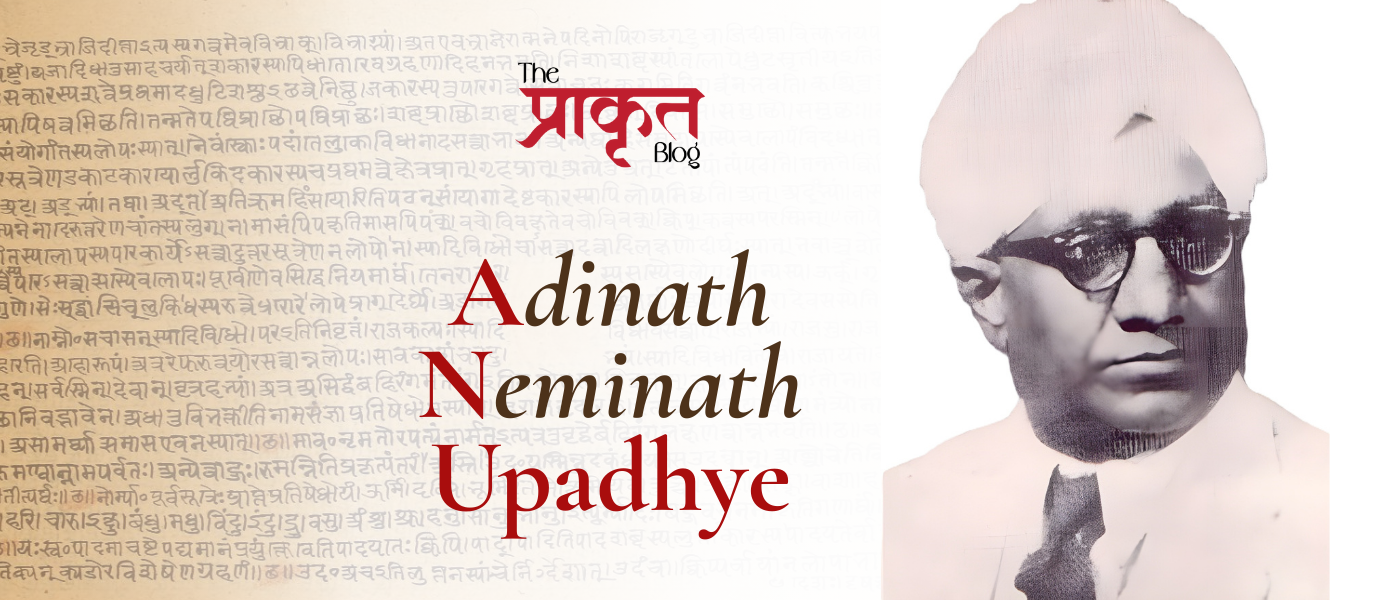
A. N. Upadhye: Scholar of Prakrit and Jainology
Adinath Neminath Upadhye (1906–1975) stands as the preeminent figure in twentieth-century Prakrit studies, having contributed more comprehensively to the scientific investigation of Prakrit languages and Jain literature than perhaps any other modern Indian scholar. His unexpected death on October 8, 1975, prompted the immediate reaction among colleagues that "Alas! Prakritology is now disconsolately orphaned"—a testament to the singular stature he had achieved in the field.
Born on February 6, 1906, in Sadalga, Belgaum district (Karnataka), Upadhye came from a priestly family that had turned to agriculture. After completing his early education at Sadalga, Belgaum, and Kolhapur, he enrolled at Willingdon College, Sangli, where he encountered Professor P. L. Vaidya, who initiated him into Prakrit studies and revealed the field's research possibilities. Throughout his career, Upadhye acknowledged this foundational debt with evident gratitude, while Vaidya took legitimate pride in his student's achievements.
For postgraduate work, Upadhye joined the Bhandarkar Oriental Research Institute, Poona, coming under the influence of two formative scholars: S. K. Belvalkar and V. S. Sukthankar. Belvalkar cautioned against attempting too much simultaneously, urging concentration on "the very best and highest." Sukthankar emphasized the critical importance of textual scholarship, writing to Upadhye that "only a sound and critically edited text can serve as foundation of further research in literature." These principles, validated by his mentors' own work, guided Upadhye's subsequent scholarly endeavors.
After receiving his M.A. in 1930 with Prakrit as principal subject (first class), Upadhye was appointed Lecturer in Ardhamāgadhī at Rajaram College, Kolhapur, confirmed as Professor in 1933, and served nearly thirty years in that capacity. He obtained his D.Litt. from Bombay University in 1939. From 1962 to 1971, he worked under the University Grants Commission's scheme for utilizing retired teachers, subsequently accepting the newly established Professorship of Jainology and Prakrits at Mysore University, from which he retired just one month before his death.
Upadhye's scholarly output was prodigious. A 1957 bibliography (compiled upon his fiftieth year) listed 13 books, 98 papers, and 56 reviews. By 1975, his books had risen to 28, with proportionate increases in editorial work. His debut publication, a critical edition of Pañcasuttaṃ, earned commendation from Schübring, Barnett, and Winternitz. Subsequently, he produced critical editions of major works including Kundakunda's Pravacanasāra, Yogīndudeva's Paramārtha-prakāśa, Jaṭāsiṃhanandīn's Varaṅgacarita, and Hariṣeṇa's Bṛhat-kathākośa, among many others. His exhaustive introductions functioned as comprehensive chapters in Prakrit literary history and Jain religious philosophy, establishing models for Sanskrit and Prakrit textual scholarship.
Particularly fruitful was Upadhye's collaboration with Professor Hiralal Jain. Together they produced the critical edition of Dhavalā (sixteen volumes) and served as Joint General Editors of the Mūrtidevī Granthamālā (over sixty volumes) and Jīvarāja Granthamālā, Sholapur (approximately eighty volumes). Upadhye also served as General Editor of the Manikchandra Digambar Jain Granthamālā (fifty-five volumes).
Honors included presidency of the Prakrit and Jainism section at the All-India Oriental Conference (Hyderabad, 1941), General Presidency of the same conference (Aligarh, 1966), presidency of the Kannada Sāhitya Sammelana (Shravanabelagola, 1967), and participation in international congresses. Most poignantly, he died less than two months after receiving from India's President a Certificate of Honour with life annuity for distinguished services to Indian Classical Studies (August 15, 1975).