Introduction
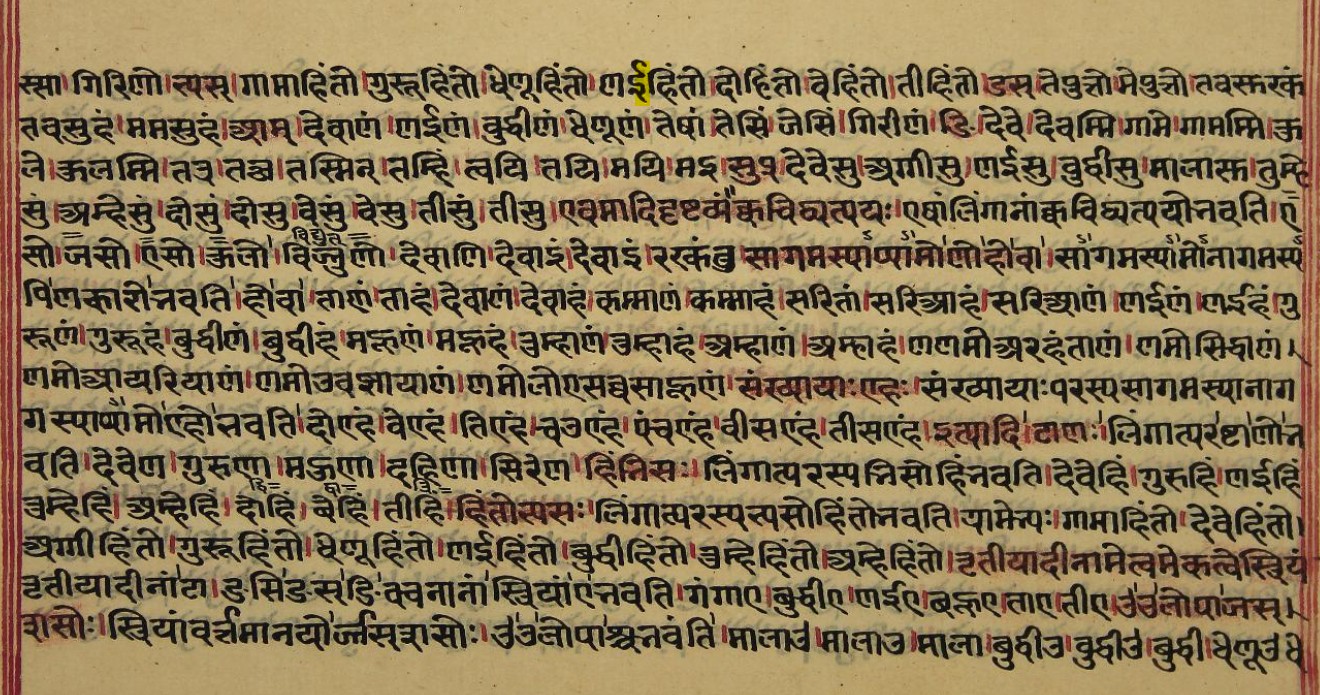
Prakrit, derived from the Sanskrit word प्राकृत (prākṛta), meaning "natural" or "original," refers to a group of Middle Indo-Aryan languages that evolved from Sanskrit. These languages were spoken across various regions of ancient India and played a crucial role in the development of Indian literature, particularly in Jain and Buddhist texts.
The study of Prakrit grammar is essential for understanding the linguistic evolution of the Indian subcontinent and for accessing a vast corpus of classical literature. This article provides a systematic introduction to the fundamental aspects of Prakrit grammar.
Phonology
Prakrit phonology exhibits several characteristic features that distinguish it from Sanskrit:
Vowel Changes
One of the most notable features of Prakrit is the systematic transformation of Sanskrit vowels:
Consonant Changes
Prakrit also shows significant consonant changes, particularly in the simplification of consonant clusters:
| Sanskrit | Prakrit | Meaning |
|---|---|---|
| सत्य | सच्च | truth |
| कर्म | कम्म | action |
| धर्म | धम्म | religion |
Morphology
Prakrit morphology is characterized by the simplification of grammatical forms while maintaining the essential structure of the language.
Noun Declension
Prakrit nouns follow a simplified declension system compared to Sanskrit:
Verb Conjugation
Verb conjugation in Prakrit shows systematic changes from Sanskrit patterns:
The verb गच्छति (gacchati) in Sanskrit becomes गच्छइ (gacchai) in Prakrit, demonstrating the characteristic vowel changes.
Syntax
Prakrit syntax generally follows the same basic patterns as Sanskrit, with some notable differences:
Word Order
While Prakrit maintains the flexible word order characteristic of Sanskrit, there is a tendency toward Subject-Object-Verb (SOV) order:
Practical Examples
Let's examine some practical examples from classical Prakrit literature:
Example from Gāhā-sattasaī
This example demonstrates several key features of Prakrit grammar:
- The use of ण (ṇa) instead of न (na)
- The ending -ओ (-o) for masculine nominative singular
- The particle वि (vi) meaning "even" or "also"
Conclusion
The study of Prakrit grammar opens up a rich world of classical Indian literature and provides insights into the linguistic evolution of the Indian subcontinent. While Prakrit may appear complex at first, its systematic nature makes it accessible to dedicated learners.
For those interested in further study, we recommend exploring specific Prakrit dialects such as Maharashtri, Ardhamagadhi, and Sauraseni, each with their own unique characteristics and literary traditions.


