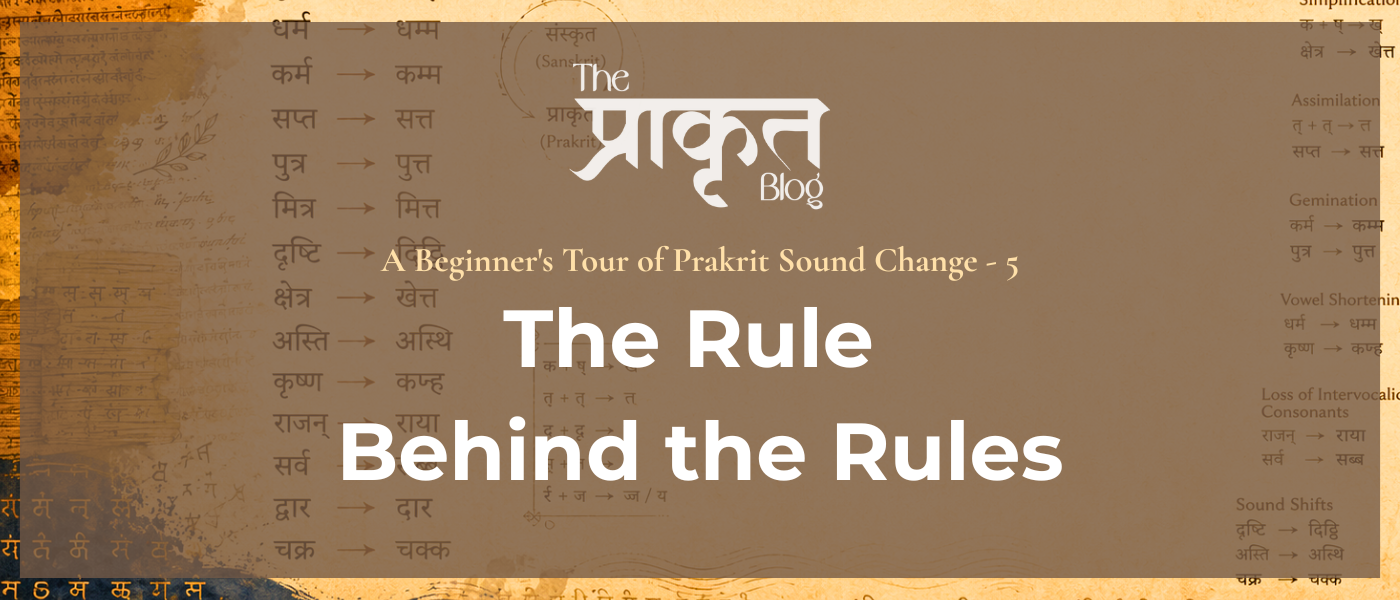
In the previous post we walked through the famous named cluster substitutions — kṣa → kkha, tya → cca, sta → ttha, and the rest. Behind all of them sits a much simpler mechanism that Hemacandra states in just two rules. If you understand these two rules, you can predict what Prakrit will do with a cluster you have never seen before.
A note on the trailing “a”. In Devanāgarī every consonant sign carries a built-in a — क is ka, so the cluster त्य is written tya and its Prakrit result च्च is written cca. In a change such as त्य → च्च (tya → cca) or ट → ड (ṭa → ḍa), only the consonants actually change; the a is there just so the letters can be pronounced.
The upper-and-lower rule
When Sanskrit has a two-consonant cluster, Prakrit asks a simple question: which of the two consonants is more sonorous? The less-sonorous one is elided, and the more-sonorous one is doubled to fill the space. Hemacandra puts this in two complementary rules.
Rule one. If the cluster ends in one of क, ग, ट, ड, त, द, पk, g, ṭ, ḍ, t, d, p, or the sibilants श, ष, सś, ṣ, s — that is, a stop or sibilant — the first (upper) consonant drops and the second (lower) doubles.
| Sanskrit | Prakrit | What happened |
|---|---|---|
| भुक्तbhukta | भुत्तbhutta | k dropped, t doubled |
| दुग्धdugdha | दुद्धduddha | g dropped, dh doubled |
| उत्पलutpala | उप्पलuppala | t dropped, p doubled |
| मुग्धmugdha | मुद्धmuddha | g dropped, dh doubled |
| खड्गkhaḍga | खग्गkhagga | ḍ dropped, g doubled |
| सिक्तsikta | सित्तsitta | k dropped, t doubled |
Rule two. If the cluster ends in मm, नn, or यy, the opposite happens — the first (upper) consonant survives and doubles, while the second (lower) drops.
| Sanskrit | Prakrit | What happened |
|---|---|---|
| युग्मyugma | जुग्गjugga | m dropped, g doubled |
| नग्नnagna | नग्गnagga | n dropped, g doubled |
| लग्नlagna | लग्गlagga | n dropped, g doubled |
| कुड्यkuḍya | कुड्डkuḍḍa | y dropped, ḍ doubled |
| बाह्यbāhya | बाहbāha | y dropped |
That is it. Between these two rules, almost every cluster in Sanskrit has a predictable Prakrit outcome. The named substitutions from the last post are just the specific results of these two general rules applied to specific input clusters.
क्षKṣa → क्खkkha is really कk + षṣa: the कk is elided, the षṣ would become सs, and then… well, actually, this specific case is a named exception because the sibilant would produce स्सssa by mechanical rule. Hemacandra names खkha as the outcome instead. But you can see the family resemblance.
And the semivowels vanish everywhere
There is a third small rule that catches semivowels — the sounds लl, वv, and रr. Wherever they appear inside a cluster, either as the upper or the lower member, they are elided.
| Sanskrit | Prakrit | Meaning |
|---|---|---|
| ऊर्ध्वūrdhva | उद्धuddha | upward |
| चन्द्रcandra | चन्दcanda | moon |
| भद्रbhadra | भद्दbhadda | good |
| समुद्रsamudra | समुद्दsamudda | ocean |
This is why Prakrit almost never contains a रr or वv inside a cluster. If Sanskrit had न्द्रndra, Prakrit will have न्दnda. If Sanskrit had प्रpra, Prakrit will usually just have पpa (with the following consonant doubled).
Sometimes a vowel is inserted
Not every cluster can be resolved by dropping one consonant. Some Sanskrit clusters resist that treatment, and Prakrit responds by slipping a vowel — usually अa, इi, or उu — between the two consonants. This is called svarabhakti (literally "vowel-fragmentation"), and it is Prakrit's way of pulling the cluster apart from within.
| Sanskrit | Prakrit | Meaning |
|---|---|---|
| रत्नratna | रयणrayaṇa | jewel |
| श्रीśrī | सिरीsirī | fortune |
| ह्रीhrī | हिरीhirī | modesty |
| स्नानsnāna | सणेहsaṇeha | (also with epenthesis) |
| श्लाघाślāghā | सलाहाsalāhā | praise |
| अर्हतिarhati | अरिहइarihaï | he deserves |
| क्लिन्नklinna | किलिन्नkilinna | wet |
| स्यात्syāt | सिआsiā | may be |
You can see the effect clearly in रत्नratna → रयणrayaṇa: the cluster त्नtn would violate the general rules, so a small अa is inserted (and the तt softens the way we saw in earlier posts). The word grows by a syllable but each syllable is now easy to say.
A final courtesy: doubling has limits
The rule that a residual consonant doubles has three quiet exceptions:
- After a long vowel, the consonant does not double. छूढchūḍha stays छूढchūḍha — the ū has already made the syllable heavy.
- After an anusvāra (nasal), the consonant does not double.
- The consonants रr and हh never double. They simply cannot geminate in Prakrit.
These small brakes on the doubling rule keep Prakrit from producing forms that would be awkward to pronounce.
A tour concludes
Across three posts (five if you count the splits) we have looked at what happens to Sanskrit sounds as they cross into Prakrit. The picture is not complicated once you see the shape of it:
- Vowels simplify, and long ones shorten before clusters.
- Single consonants between vowels either drop, become h, or soften a step.
- Consonant clusters either substitute wholesale into standard outcomes, or resolve by elision-plus-doubling, or split apart with an inserted vowel.
Hemacandra's grammar catalogues all of this in almost seven hundred aphorisms across four pādas, with careful exceptions marked at every turn. What we have covered here is the mainstream — the general rules that account for most Prakrit words you will actually read. The exceptions are worth learning too, but they will make far more sense once the general shape is in your ear.