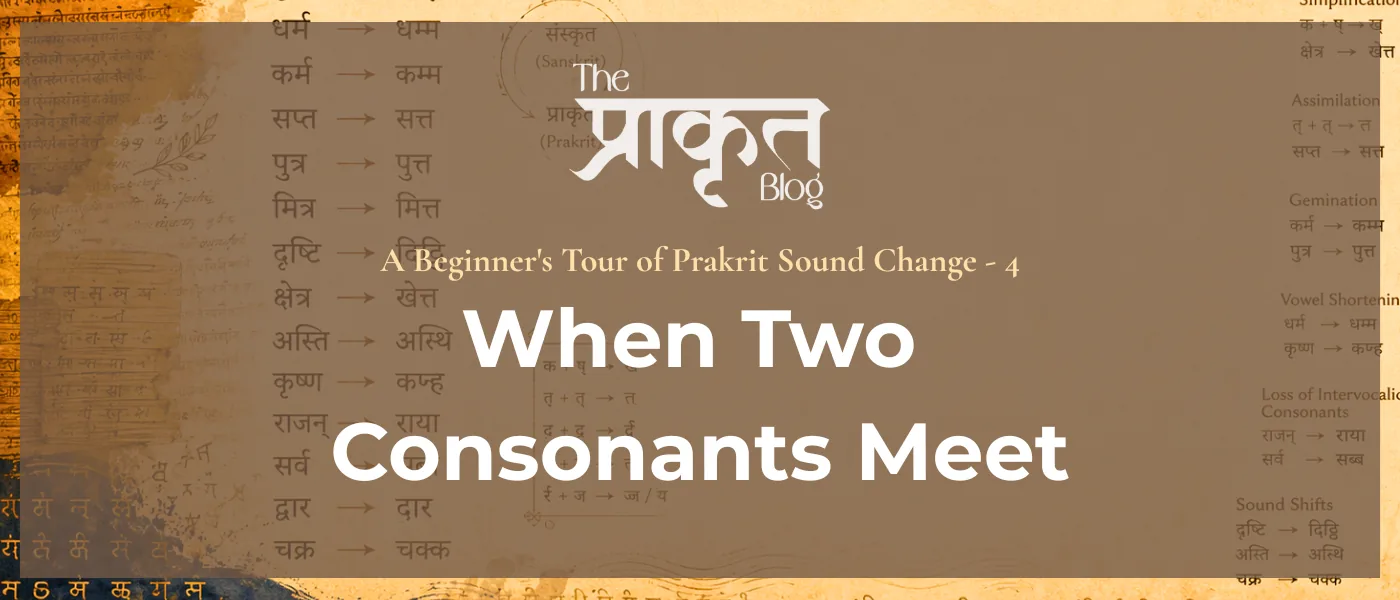
Sanskrit is comfortable with consonant clusters. It piles them up cheerfully: kārtsnya (five consonants in a row!), pratyaya, jñāna, aśva, tāmra. Prakrit does not share this taste. When it inherits a cluster, it does something about it.
Sometimes it substitutes the whole cluster with something new. Sometimes it drops one of the consonants and doubles the other. Sometimes it slips a vowel in between them to pull them apart. This post looks at the first strategy — the specific, named substitutions. The next and final post looks at the general mechanism.
Nearly all of the transformations below sit in the second pāda of Hemacandra's grammar. There are dozens of them, but a handful account for most of the vocabulary you will actually meet.
A note on the trailing “a”. In Devanāgarī every consonant sign carries a built-in a — क is ka, so the cluster त्य is written tya and its Prakrit result च्च is written cca. In a change such as त्य → च्च (tya → cca) or ट → ड (ṭa → ḍa), only the consonants actually change; the a is there just so the letters can be pronounced.
kṣa becomes kha
The Sanskrit cluster क्षkṣa is one of the most common in the language, appearing in words like लक्षणlakṣaṇa, क्षयkṣaya, अक्षरakṣara, मोक्षmokṣa. In Prakrit its default outcome is खkha — the aspirated velar.
| Sanskrit | Prakrit | Meaning |
|---|---|---|
| क्षयkṣaya | खअkhaa | destruction |
| लक्षणlakṣaṇa | लक्खणlakkhaṇa | mark |
| अक्षरakṣara | अक्खरakkhara | syllable |
| रक्षतिrakṣati | रक्खइrakkhaï | protects |
Notice the doubling: लक्षणlakṣaṇa does not become lakhaṇa but लक्खणlakkhaṇa. That doubling is a general feature of how Prakrit resolves clusters, and we will come back to it in the next post.
There is a small family of words in which क्षkṣa becomes not खkha but च्छccha — अक्षिakṣi "eye" becomes अच्छिacchi, वृक्षvṛkṣa "tree" becomes वच्छvaccha, लक्ष्मीlakṣmī becomes लच्छीlacchī. This is a lexically-specific exception, but it happens often enough that these are the forms you actually see in most texts.
The palatal transformations
A group of Sanskrit clusters ending in the vowel यya — namely त्यtya, द्यdya, ध्यdhya, ह्यhya, र्यrya — all become palatal geminates in Prakrit.
- त्यtya → च्चcca
- द्यdya, य्यyya, र्यrya → ज्जjja
- ध्यdhya, ह्यhya → ज्झjjha
| Sanskrit | Prakrit | Meaning |
|---|---|---|
| सत्यsatya | सच्चsacca | truth |
| प्रत्ययpratyaya | पच्चअpaccaa | conviction |
| मध्यmadhya | मज्झmajja | middle |
| कार्यkārya | कज्जkajja | work |
| शय्याśayyā | सेज्जाsejjā | bed |
| ध्यानdhyāna | झाणjhāṇa | meditation |
| गुह्यguhya | गुज्झgujjha | secret |
| उपाध्यायupādhyāya | उवज्झाअuvajjhāa | teacher |
If you meet a Prakrit word with च्चcca, ज्जjja, or ज्झjjha, it is a very safe bet that the underlying Sanskrit cluster was one of these. The palatalisation is one of the most reliable diagnostics in the language.
The dental sta
Sanskrit स्तsta — the स्s + त्t cluster that appears in words like hasta, stuti, prastara — regularly becomes त्थttha in Prakrit.
| Sanskrit | Prakrit | Meaning |
|---|---|---|
| हस्तhasta | हत्थhattha | hand |
| स्तुतिstuti | थुइthui | praise |
| प्रस्तरprastara | पत्थरpatthara | stone |
| प्रशस्तpraśasta | पसत्थpasattha | praiseworthy |
The retroflex ṣṭa
ष्टṢṭa — the retroflex cluster in words like इष्टiṣṭa, दृष्टिdṛṣṭi — becomes ट्ठṭṭha.
| Sanskrit | Prakrit | Meaning |
|---|---|---|
| इष्टiṣṭa | इट्ठiṭṭha | desired |
| दृष्टिdṛṣṭi | दिट्ठिdiṭṭhi | sight |
| मुष्टिmuṣṭi | मुट्ठिmuṭṭhi | fist |
| यष्टिyaṣṭi | लट्ठिlaṭṭhi | staff |
There is a small handful of words that don't follow this — उष्ट्रuṣṭra "camel" keeps a ट्टṭṭ rather than ट्ठṭṭh — but the general rule catches the vast majority.
The nasal clusters
Sanskrit ज्ञjña (the ञñ-plus-जj combo in ज्ञानjñāna, प्रज्ञाprajñā) and Sanskrit म्नmna (in निम्नnimna, प्रद्युम्नpradyumna) both collapse into the same Prakrit outcome: ण्णṇṇa.
| Sanskrit | Prakrit | Meaning |
|---|---|---|
| ज्ञानjñāna | णाणṇāṇa | knowledge |
| प्रज्ञाprajñā | पण्णाpaṇṇā | wisdom |
| सर्वज्ञsarvajña | सव्वण्णूsavvaṇṇū | omniscient |
| निम्नnimna | णिण्णṇiṇṇa | low |
Two different Sanskrit sources, one Prakrit outcome — another example of Prakrit's tendency to reduce and unify.
Sanskrit श्मśma, ष्मṣma, स्मsma, and ह्मhma — the various मm-final nasal clusters — all become म्हmha. And श्नśna, ष्णṣṇa, स्नsna, ह्नhna, क्ष्णkṣṇa all become ण्हṇha.
| Sanskrit | Prakrit | Meaning |
|---|---|---|
| ग्रीष्मgrīṣma | गिम्हgimha | summer |
| स्नानsnāna | ण्हाणṇhāṇa | bath |
| प्रश्नpraśna | पण्हpaṇha | question |
| तीक्ष्णtīkṣṇa | तिण्हtiṇha | sharp |
The pattern is consistent: whatever the sibilant or aspirate at the front of the cluster, the मm pulls it into म्हmha and the नn pulls it into ण्हṇha.
The ṣpa / spa → ppha
Sanskrit clusters starting with a sibilant and ending in पp — puṣpa, spandana, niṣpāva — become प्फppha.
| Sanskrit | Prakrit | Meaning |
|---|---|---|
| पुष्पpuṣpa | पुप्फpuppha | flower |
| स्पन्दनspandana | फन्दणphandaṇa | throbbing |
The sibilant is absorbed, the ph aspirates and doubles. Same pattern again.
Do you see the shape yet?
Look back at the whole set. In almost every case, Prakrit takes a two-consonant cluster and produces either:
- a doubled consonant (क्खkkha, च्चcca, ज्जjja, त्थttha, ट्ठṭṭha, ण्णṇṇa, म्हmha, ण्हṇha, प्फppha), or
- a doubled consonant with a slight change of quality — an aspirate emerges, or the voicing shifts, or one member is lost.
This is not coincidence. There is one deep mechanism underlying all of them, and it is the subject of the last post: how Prakrit systematically decides which member of a cluster survives and how it doubles.