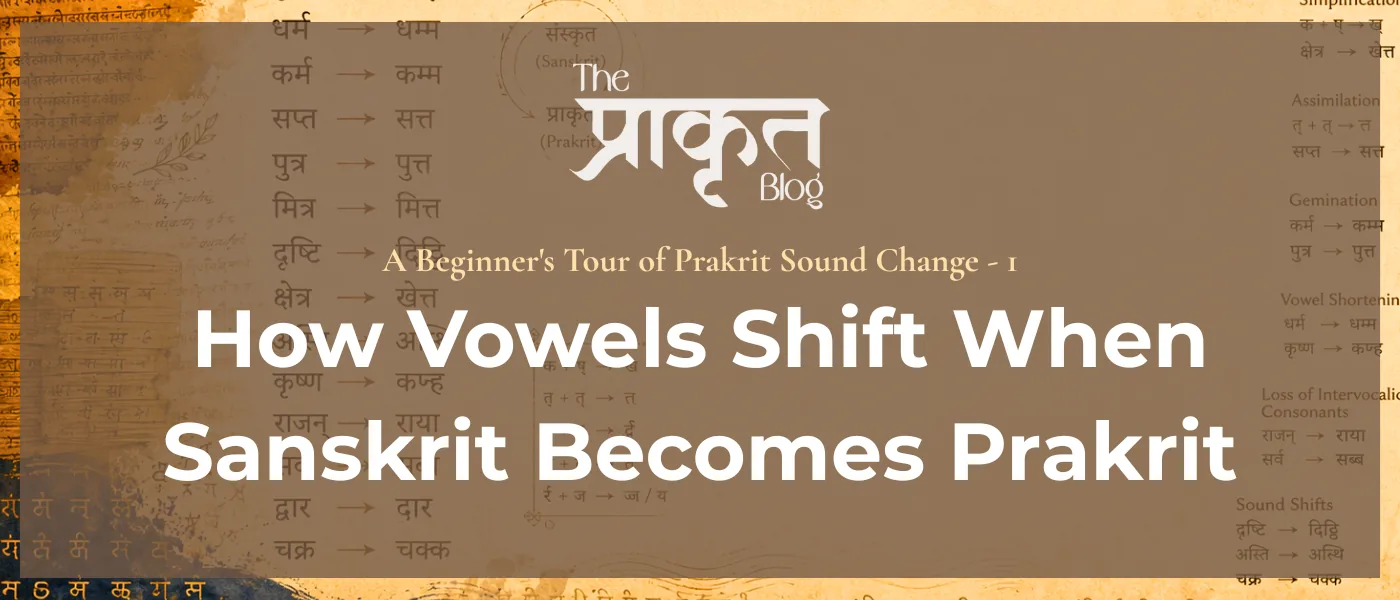
If you know a little Sanskrit and you open a Prakrit text for the first time, the words look almost familiar — as if someone had taken your favourite Sanskrit vocabulary and gently softened the corners. That softening is not random. Hemacandra, writing in the twelfth century, catalogued every one of these shifts in his grammar, the Siddhahema. This post is a short tour of what he found for vowels.
We will not learn everything. The goal is only to give you a feel for the landscape, so that when you meet a Prakrit word in the wild you can say, "Ah — I see where that came from."
A note on the trailing “a”. In Devanāgarī every consonant sign carries a built-in a — क is ka, so the cluster त्य is written tya and its Prakrit result च्च is written cca. In a change such as त्य → च्च (tya → cca) or ट → ड (ṭa → ḍa), only the consonants actually change; the a is there just so the letters can be pronounced.
The vowels Prakrit does not have
Sanskrit has a rich vowel inventory. Prakrit trims it down. Three sets of Sanskrit vowels essentially disappear:
- The vocalic liquids ऋ, ॠ, ऌ, ॡṛ, ṝ, ḷ, ḹ — the little r-vowels and l-vowels in words like कृतkṛta and मृगmṛga.
- The diphthongs ऐai and औau — usually. Some authorities keep them; most collapse them into simpler vowels.
That leaves Prakrit with eight working vowels: अ, आ, इ, ई, उ, ऊ, ए, ओa, ā, i, ī, u, ū, e, o. Every Sanskrit vowel that isn't in this list has to become one that is. That single fact drives a huge amount of what follows.
What happens to ṛ
Sanskrit ऋṛ is the most common of the vocalic liquids, and Prakrit's default response is simple: it becomes short अa.
| Sanskrit | Prakrit | Meaning |
|---|---|---|
| कृतkṛta | कयkaya | done |
| घृतghṛta | घयghaya | ghee |
| मृगmṛga | मअmaa | deer |
| वृषभvṛṣabha | वसहvasaha | bull |
But ऋṛ has other lives too. In a smaller set of words it becomes इi (as in कृपाkṛpā → किवाkivā, "pity"), and in another set it becomes उu (as in ऋतुṛtu → उउuu, "season"). When ऋṛ stands alone at the start of a word without any consonant attached, it becomes रिri — so ऋद्धिṛddhi "prosperity" appears as रिद्धिriddhi.
Which of these outcomes you get depends on the word. There is a general default (अa) and a handful of lexical pockets that take इi, उu, or रिri instead. When you learn Prakrit vocabulary, you learn which pocket a given Sanskrit word belongs to.
What happens to the diphthongs
The two Sanskrit diphthongs ऐai and औau simplify at the start of a word:
- ऐai becomes एe
- औau becomes ओo
| Sanskrit | Prakrit | Meaning |
|---|---|---|
| वैद्यvaidya | वेज्जvejja | physician |
| शैलśaila | सेलsela | mountain |
| कौमुदीkaumudī | कोमुईkomuī | moonlight |
| यौवनyauvana | जोव्वणjovvaṇa | youth |
There is a small exception. A group of words — दैत्यdaitya, भैरवbhairava, दैन्यdainya and a few others — keep the diphthong but spell it out as अइaï (two syllables). So दैत्यdaitya "demon" appears as दइच्चdaïcca. If you see a Prakrit word with अइaï or अउaü, that's often what has happened.
Long vowels shorten before a cluster
Here is a rule that catches people off guard because it applies quietly, right in the middle of a word. Whenever a long vowel would sit directly before a consonant cluster in Prakrit, that vowel shortens.
| Sanskrit | Prakrit | Meaning |
|---|---|---|
| आम्रāmra | अम्बamba | mango |
| ताम्रtāmra | तम्बtamba | copper |
| आस्यāsya | अस्सassa | mouth |
Notice what happens with आम्रāmra ― the आā shortens to अa, and separately the cluster म्रmr becomes म्बmb. Two changes are stacking on top of each other. This is very typical of Prakrit — several rules touch the same word, and the final form is the product of all of them.
Compensatory lengthening — a shortening rule that lengthens
Sometimes a consonant drops out and the vowel next to it "absorbs" the lost sound by growing longer. This happens when यy, रr, वv or a sibilant is elided in a cluster with a sibilant.
| Sanskrit | Prakrit | Meaning |
|---|---|---|
| पश्यतिpaśyati | पासइpāsaï | he sees |
| अश्वaśva | आसāsa | horse |
| विश्रामviśrāma | वीसामvīsāma | rest |
Here पश्यतिpaśyati loses the यy, but the preceding अa stretches into आā to compensate. The word feels balanced again. This is one of the most important rules to know because it produces so many familiar-looking Prakrit words with long vowels where you might have expected short ones.
Compounds are flexible with length
Inside a compound, vowels can shorten or lengthen freely. Hemacandra explicitly says this variation is optional. So the same underlying compound might show up two different ways in two different texts:
| Sanskrit | Prakrit variants | Meaning |
|---|---|---|
| वधूमुखvadhū-mukha | वहुमुहvahu-muha or वहूमुहvahū-muha | bride's face |
| नदीस्रोतस्nadī-srotas | नइसोत्तnaï-sotta or नईसोत्तnaī-sotta | river's current |
Neither form is wrong. This is the vikalpa principle — Hemacandra's way of saying "in practice, both are found." A translator or a learner has to accept that Prakrit is a bit more relaxed than Sanskrit about these small choices.
A quick note on hiatus
Sanskrit hates two vowels sitting next to each other, and its sandhi rules exist to smooth them out. Prakrit is the opposite — it is perfectly content with hiatus. When two vowels meet inside a Prakrit word, they usually just sit there, unmerged.
पादःpādaḥ "foot" in Sanskrit becomes पाओpāo in Prakrit, with two vowels in a row. In Sanskrit that would trigger sandhi; in Prakrit it is the norm. This gives Prakrit its characteristic open, flowing sound.
What to take away
The vowel changes from Sanskrit to Prakrit are less about strict transformation and more about simplification and flow. The alphabet shrinks. Difficult vowels like ṛ find easier substitutes. Long vowels pull back when they meet clusters. Consonants can drop out and let the vowels sing. And where Sanskrit insists on merging vowels together, Prakrit leaves them side by side.
In the next post we will turn to consonants — first the single, non-conjunct ones, where the language performs its most famous trick: making sounds vanish altogether.